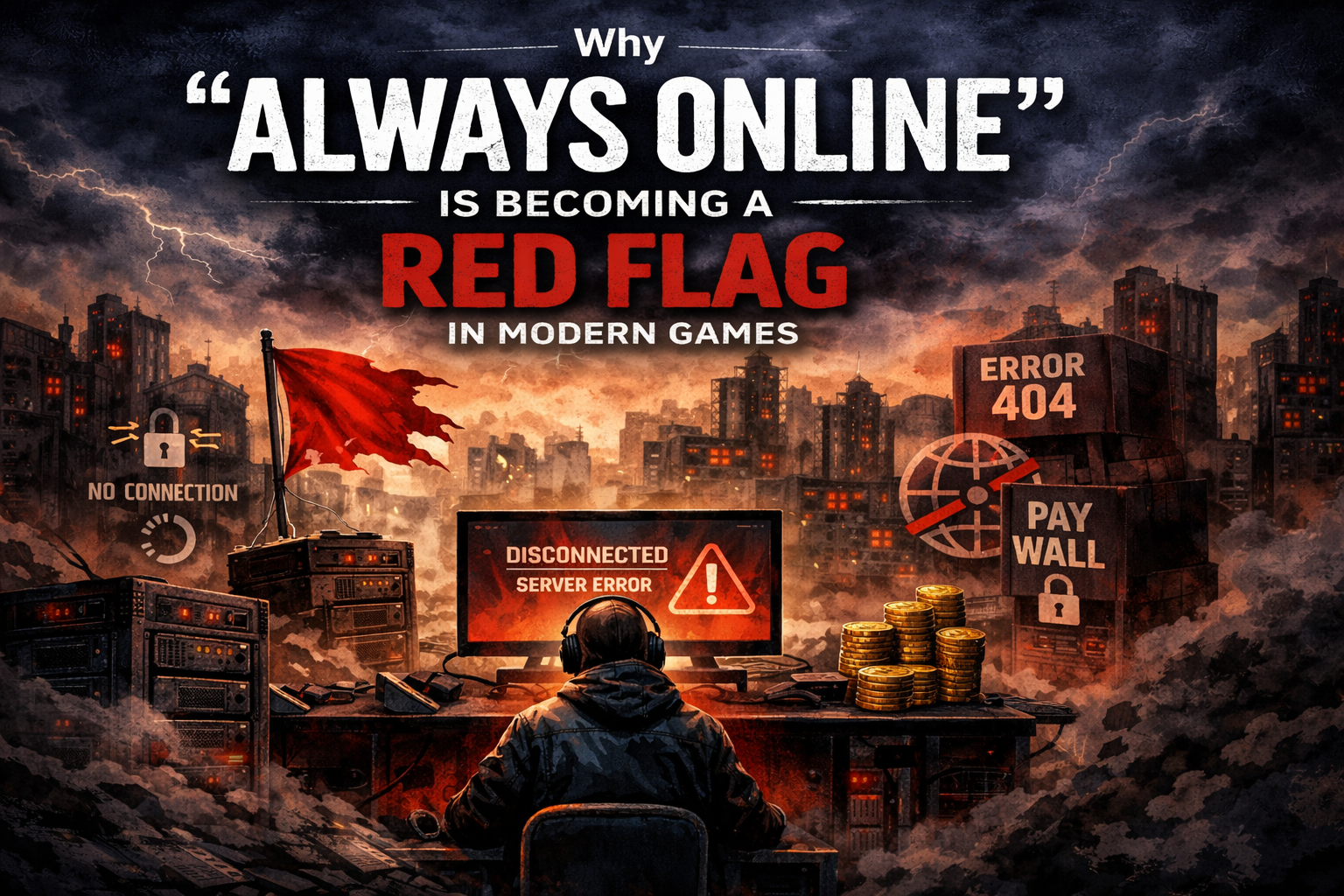
Why “Always Online” Is Becoming a Red Flag in Modern Games
Sat Jan 17 2026
Why “Always Online” Is Becoming a Red Flag in Modern Games
There was a time when “always online” sounded like a feature. Persistent worlds, shared events, evolving content—these ideas promised games that felt alive. Today, the phrase carries a different weight. For many players, it has become a warning label.
The shift didn’t happen overnight. It emerged slowly, through shutdowns, lost access, and the quiet realization that some games are built to disappear as easily as they arrive. What once signaled ambition now signals risk.
When Connectivity Became a Requirement, Not an Enhancement
Online connectivity used to expand what a game could do. Leaderboards, co-op, seasonal events—all optional layers added on top of a complete experience. Over time, that balance flipped.
Modern always-online games often place their core systems behind a server handshake. Progression, inventory, even single-player modes depend on remote validation. The game doesn’t just benefit from being online; it requires it.
That requirement changes the relationship between player and product. Ownership becomes access. Access becomes conditional.
The Fragility Players Don’t See at Launch
At release, always-online games look robust. Servers are full. Roadmaps are ambitious. Support teams are active. The illusion is stability.
What’s less visible is how narrow the margin can be once engagement slows. Server costs don’t scale down gracefully. Compliance, security, and live ops overhead remain constant. Content expectations never reset.
When momentum fades, the entire structure becomes brittle. A game that cannot exist offline has no fallback state. There is no “finished” version to preserve—only a switch that can be flipped.
Why Publishers Keep Choosing This Model Anyway
From a business perspective, always-online design still makes sense. It allows tighter control over economies, easier updates, and clearer data on player behavior. It also reduces piracy and supports monetization strategies that rely on constant engagement.
But these advantages come with tradeoffs that are rarely acknowledged upfront. The more control a publisher retains, the more responsibility they assume for a game’s continued existence. When that responsibility outweighs the return, the model collapses inward.
This is where trust erodes.
The Player Experience After the Honeymoon Ends
Players are adapting, whether publishers intend it or not.
Many now approach always-online games with shorter time horizons. They engage deeply for a season, then move on. Long-term attachment feels risky when history suggests that access can vanish without ceremony.
This isn’t cynicism. It’s pattern recognition.
Once players internalize that a game’s lifespan is provisional, the emotional ceiling lowers. Fewer people build identity around these worlds. Fewer invest in mastery that assumes permanence.
Always Online vs. Built to Last
The contrast becomes clear when compared to games designed to stand on their own.
A self-contained game can be revisited years later. Mods can extend it. Communities can preserve it. Even if official support ends, the experience remains intact.
Always-online games don’t offer that resilience. When support ends, so does the game. No patch can change that. No community effort can restore what was never designed to exist independently.
This is why the phrase has become loaded. It doesn’t describe a technical choice. It describes a lifespan.
Where This Leaves Modern Gaming
Always-online games aren’t going away. Some still justify the model through scale, consistency, and genuine ongoing value. But players are no longer taking permanence on faith.
The industry is adjusting in subtle ways. More games are shipping with offline modes. Others are narrowing their live-service ambitions. Some are quietly planning end states from the beginning.
The promise hasn’t changed. The skepticism has.
For players, “always online” no longer answers what a game offers. It raises a more important question: how long will this be allowed to exist?
For more analysis on how modern games are changing, read our breakdown of Why Anthem’s Shutdown Proves Live-Service Games Are a Long-Term Risk.